
|
Skin cancer is common!
- 1 out of 5 Americans will develop skin cancer sometime during their lifetime.
- Over one million new cases of skin cancer are diagnosed every year in the U.S.
Skin cancer can by deadly
- Melanaoma, the dangerous form of skin cancer, can be very aggressive once it spreads from the skin.
- Melanoma kills over 8000 people in this country every year.
Ultraviolet light from the sun causes skin cancer
- Over 90% of all skin cancers are caused by the sun.
- When a person gets five sunburns, or one blistering sunburn, their risk of getting a skin cancer doubles.
- More sun exposure, including tanning, means a greater risk of developing skin cancer.
- Ultraviolet light from tanning booths causes skin cancer just like the ultraviolet light from the sun.
- In addition to causing skin cancer, ultraviolet light wrinkles the skin and makes a person look older than they really are.
Skin cancer can be prevented with good sun protection
- Protecting yourself from the sun does not mean staying indoors – it means taking a few extra steps to make sure your skin is safe.
Early detection is key.
- The most important factor in the successful treatment of skin cancer is early detection and treatment.
Catching a skin cancer early always makes it easy to treat, and for melanomas, early detection can be life-saving!
Basal
cell carcinoma accounts for about 80% of all skin cancers. This
type of tumor usually develops in sun-exposed areas, especially
the face, neck and ears. Once considered a disease of the elderly,
basal cell carcinoma is now frequently seen in younger people. The
rise among young people is primarily due to a lifestyle shift towards
outdoor activity and increased sun exposure.
Basal cell carcinoma is slow growing and does not usually spread
to distant parts of the body. If left untreated, however, basal
cell cancer can spread to nearby areas and invade the tissues beneath
the skin.
Warning signs for basal cell carcinoma include a new shiny pink
bump or a persistent red patch. They can also appear as sores that
ooze, bleed and wont go away. Skin growths that fit these
characteristics are highly suspicious. When a physician suspects
basal cell carcinoma, a skin biopsy is required to confirm the diagnosis.
After confirmation, treatment will vary based on location and tumor
subtype. Aggressive tumors, recurrent tumors, or tumors on cosmetically
important locations like the nose, lip, or ear are usually surgically
removed with a specialized technique called Mohs surgery. Tumors
in other locations can often be treated with standard surgical removal.
Following
treatment, yearly follow-up is necessary for people who have had
basal cell carcinoma because one-third of patients will develop
a new tumor within three to five years.
Learn more about basal cell carcinoma from:
Skin Cancer Foundation
www.skincancer.org/basal/index.php
American Academy of Dermatology
www.aad.org/public/Publications/pamphlets/BasalCellCarcinoma.htm
About
16% of skin cancers are squamous cell carcinomas. Chronic exposure
to sunlight is the cause of most cases of squamous cell carcinoma.
That is why tumors appear most frequently on sun-exposed parts of
the body: the face, neck, bald scalp, hands, shoulders, arms, and
back. The rim of the ear and the lower lip are especially vulnerable
to the development of these cancers.
Although squamous cell carcinomas usually remain confined to the
skin, they tend to be more aggressive than basal cell carcinoma.
They will eventually penetrate the underlying tissues if not treated.
In a small percentage of cases, they spread (metastasize) to distant
tissues and organs. When this happens, they can be fatal. For these
reasons, squamous cell carcinomas must be treated aggressively.
Squamous cell carcinomas can appear as wart-like growths that crust
and bleed. They can also develop as persistent red patches or thick
rough bumps. Any sore that oozes and bleeds is suspicious. Sores
on the lips, including small ulcers, could also be skin cancer.
When a physician suspects squamous cell carcinoma, a skin biopsy
will be performed to confirm the diagnosis. After confirmation,
the treatment is similar to that for basal cell carcinoma. The treatment
will vary based on location and tumor subtype. Aggressive tumors,
recurrent tumors, or tumors on cosmetically important locations
like the nose, lip, or ear are usually surgically removed with a
specialized technique called Mohs surgery. Tumors in other locations
can often be treated with standard surgical removal.
Following treatment, yearly follow-up is necessary for people who
have had squamous cell carcinoma because, just like basal cell carcinoma,
one-third of patients will develop a new tumor within three to five
years.
Learn more about squamous cell carcinoma from:
Skin Cancer Foundation
www.skincancer.org/squamous
American Academy of Dermatology
www.aad.org/public/Publications/pamphlets/SquamousCellCarcinoma.htm
Of
the three main types of skin cancer, melanoma is the least common.
About 4% of skin cancers are melanoma. While melanoma is less common,
it is more dangerous.
Melanoma arises from melanocytes, the cells in the skin that make
pigment (coloring) and are responsible for tanning. Because melanoma
cells still produce pigment, these tumors often appear brown or
black.
Melanoma can appear anywhere, but is most common on the back, chest,
and legs. Sometimes it arises in an existing mole which begins to
change in shape and color. Other times it begins on normal skin
and looks like a new mole at first, but continues to grow and change.
Melanoma can strike the young as well as the elderly. In fact,
melanoma is the most common cancer in women ages 25-29.
If melanoma is detected in its earliest stages, before it has spread,
the cure rate is very high. However, melanoma is much more likely
than the other forms of skin cancer to metastasize or spread to
other parts of the body. And melanoma can be very dangerous once
it has spread. Most cases of melanoma that have metastasized can
not be cured. That is why melanoma accounts for only 4% of skin
cancers, but 77% of skin cancer deaths.
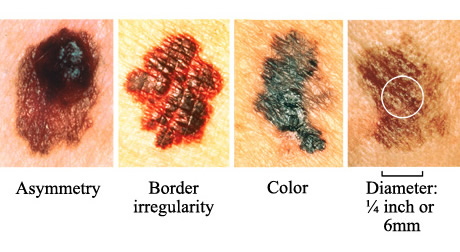
Four clues to detecting melanoma are known as the ABCDs of
melanoma:
Asymmetry
Borders are irregular
Colors are varied
Diameter is large ( > 6 mm)
A skin biopsy is necessary to confirm the diagnosis of melanoma.
Once confirmed, the tumor must be surgically removed. When a melanoma
is surgically removed, a margin of normal skin surrounding the tumor
is also removed. After removal, the depth of tumor invasion will
be measured by a pathologist using a microscope. That depth, known
as the Breslow depth, is the most important factor in determining
prognosis.
Because melanoma is so dangerous, it is important to watch the
skin for any changing moles. Those who are at greatest risk include
people with fair skin, people with lots of moles, and those with
a family member who has had melanoma. Any mole that appears to be
changing is considered highly suspicious and should be examined
and probably biopsied.
Learn more about melanoma from:
Skin Cancer Foundation
/www.skincancer.org/melanoma/index.php
American Academy of Dermatology
www.aad.org/public/Publications/pamphlets/MalignantMelanoma.htm
|